Hidden Gems and Golden Light: Kuramathi’s Shops Through My Lens
You know that magic when sunlight hits turquoise water just right? I chased that glow in Kuramathi, Maldives—and found something unexpected: soulful little shops tucked between palms, each a visual story. Forget generic malls; here, every handmade necklace, woven bag, and painted tile screams authenticity. Through my camera, these shopping spots transformed into art. Let me show you how commerce and beauty collide in the most photogenic ways.
First Impressions: Stepping Into Kuramathi’s Rhythm
Arriving at Kuramathi feels less like checking into a resort and more like stepping into a living postcard. The air carries the crispness of ocean spray and the faint sweetness of frangipani blossoms. Beneath bare feet, sand remains cool and powdery even under the morning sun, while the lagoon shifts through endless shades of turquoise and sapphire with each passing cloud. What strikes visitors immediately is how seamlessly the island’s commercial spaces integrate into this natural tapestry. There are no jarring concrete complexes or neon signs. Instead, small boutiques and artisan corners emerge organically—nestled beneath clusters of palm trees, built into coral-stone walls, or framed by flowering vines.
The island’s thoughtful design ensures that shopping is never a disruption to the experience but an extension of it. Meandering pathways lined with hand-carved wooden displays guide guests from beachfront villas to the heart of the island, where clusters of open-air kiosks offer glimpses of local craftsmanship. These are not centralized marketplaces but intimate, scattered nodes—each one appearing almost by invitation rather than demand. This dispersion creates ideal conditions for candid photography. With no large crowds funneling through a single shopping zone, moments unfold naturally. A vendor adjusts a string of shell beads in the shade. A guest pauses to examine a painted wooden fish. These quiet interactions become spontaneous compositions waiting to be captured.
Because the shops are woven into the environment, they benefit from natural framing—overhanging leaves, dappled light, and soft shadows that enhance visual depth. Photographers can approach these spaces without the artificiality often found in commercial zones. There is no need to stage a shot; the scene presents itself. Early mornings are particularly rewarding, when dew still clings to woven mats and the first rays of sun illuminate the edges of handcrafted displays. The absence of harsh midday glare allows for softer exposures, preserving the subtleties of texture and hue that define Kuramathi’s artisan economy.
The Heartbeat of Handmade: Local Artisan Stalls
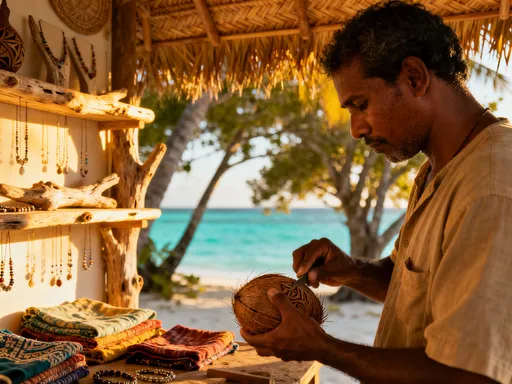
At the core of Kuramathi’s shopping experience are the artisans—individuals whose hands carry the legacy of Maldivian craft traditions. These small-scale vendors operate modest stalls, often no larger than a garden shed, yet each one pulses with cultural significance. Their wares speak of heritage: lacquer work known as liyelaa jehun, intricate coconut shell carvings, hand-beaded jewelry made from locally sourced seeds and shells, and woven mats crafted from dried palm leaves. These items are not mass-produced souvenirs but expressions of identity, shaped by techniques passed down through generations in island communities across the atolls.
What makes these stalls so compelling through a lens is their authenticity. There is no glossy packaging or uniform branding—just raw, tactile beauty. A necklace might rest on a piece of driftwood instead of a velvet tray. A carved wooden box sits half in shadow, its grooves catching the light like topographical lines on a map. These imperfections are not flaws; they are the very elements that elevate a photograph from documentation to storytelling. To capture them well, timing is essential. The golden hours—just after sunrise and before sunset—offer the most forgiving and dramatic lighting. During these windows, the low-angle sun wraps around objects, revealing depth in textures and enriching the natural tones of wood, fiber, and shell.
When photographing artisans at work, respect is paramount. Many are happy to be photographed, especially if approached with a smile and a brief gesture of permission. A simple nod or raised camera, followed by a pause for consent, goes a long way. Avoid using flash, which can feel intrusive and washes out delicate details. Instead, rely on natural illumination and a slightly higher ISO setting to maintain clarity. Focus on the hands—the calloused fingers shaping a bracelet, the careful alignment of beads, the steady brushstroke on lacquered wood. These close-ups convey labor, skill, and pride in a way that transcends language. The resulting images do more than showcase products; they honor the people behind them.
Sunset Frames: The Beachfront Boutiques
Along Kuramathi’s western shoreline, where the ocean swallows the sun each evening in a blaze of orange and violet, a series of open-air boutiques takes full advantage of their front-row seats. These retail spaces are designed as much for ambiance as for commerce, with wide verandas, palm-thatched roofs, and open sides that invite the sea breeze. Shelving is often crafted from driftwood or reclaimed timber, and display cases use glass that subtly reflects the sky. As dusk approaches, these shops transform into living galleries, where merchandise becomes part of a larger visual narrative shaped by light, motion, and atmosphere.
For photographers, this stretch offers some of the most dynamic opportunities on the island. The interplay between interior and exterior spaces allows for layered compositions—products in the foreground, the horizon in the distance, and the fading sky mirrored in glass surfaces. Long exposures become especially effective during twilight, when shutter speeds can be slowed to capture both sharp details of crafts and the soft streaks of ambient light. A 10- to 30-second exposure can turn the last glimmers of sunset into luminous gradients across a shot, while still preserving the form of a displayed fan or ceramic bowl.
Because these boutiques face west, they benefit from directional lighting that enhances dimensionality. Side lighting from the setting sun casts elongated shadows across counters, creating natural leading lines that guide the viewer’s eye through the frame. Reflections in glass or polished wood add symmetry and depth, offering dual perspectives within a single image. Photographers can experiment with angles—shooting from behind a display to include the ocean in the background, or positioning the camera low to emphasize the contrast between textured materials and smooth sand floors. The key is to let the environment contribute to the composition rather than overpower it. These shops are not just places to buy; they are stages where light, design, and culture perform daily.
Beyond Souvenirs: Curated Concept Stores
While traditional stalls celebrate heritage, Kuramathi’s more contemporary retail spaces reflect a growing emphasis on design and sustainability. Scattered within the resort’s central areas are concept stores that blend Maldivian craftsmanship with modern aesthetics. These boutiques are minimalist in presentation—white walls, clean lines, and carefully spaced displays that allow each piece to breathe. The products themselves are often elevated versions of local goods: organic cotton sarongs dyed with plant pigments, ceramic tableware inspired by coral formations, and jewelry that fuses traditional beadwork with sleek metal accents.
What sets these stores apart is their intentionality. They are curated, not crowded. Each item is chosen not just for saleability but for its story, material origin, and artistic merit. Packaging is eco-conscious—reusable fabric wraps, recycled paper tags, and minimal plastic. These details matter not only to environmentally aware travelers but also to photographers seeking refined, intentional compositions. The simplicity of these spaces makes them ideal for fine-art approaches to product photography. With fewer visual distractions, emphasis shifts to form, color, and texture.
Using symmetry and negative space becomes a powerful technique in these environments. A single necklace suspended against a white wall creates a striking focal point. A row of identical woven baskets, evenly spaced on a shelf, forms a pattern that invites the eye to linger. Reflections in glass cases or polished floors can double the visual impact, offering mirror images that add balance and intrigue. A polarizing filter helps reduce glare on glass surfaces while enhancing the saturation of natural dyes and fibers. These stores, though more polished than roadside stalls, still maintain a deep connection to place. They prove that modernity and tradition need not conflict—when thoughtfully combined, they elevate each other.
Market Moods: Capturing the Vibe, Not Just the Goods
A truly memorable photograph captures more than objects—it captures feeling. In Kuramathi’s shopping spaces, the atmosphere is often more compelling than the inventory. It lives in the way a vendor laughs while adjusting a display, how a sudden gust of wind flips the corner of a fabric banner, or how afternoon shadows stretch across a wooden counter like slow-moving hands on a clock. These fleeting moments are what transform a simple snapshot into a lasting impression.
To convey mood, photographers should shift focus from product-centric shots to environmental storytelling. Wide-angle lenses are invaluable for capturing context—the layout of a stall, the surrounding greenery, the interaction between guest and seller. These broader frames place the subject within a lived-in world, suggesting narrative beyond the immediate scene. Meanwhile, prime lenses with fixed focal lengths, such as a 50mm, excel at isolating intimate details: a hand placing a coin on the counter, sunlight catching the edge of a woven basket, or a child peeking from behind a display. These images resonate because they feel human, unscripted, and real.
Midday, often avoided for its harsh light, can actually be a time of dramatic contrast when used wisely. While direct sunlight may create strong shadows, shaded areas beneath thatched roofs offer pockets of soft, diffused illumination. Shooting at this time allows for high-contrast black-and-white conversions or bold color images that emphasize tonal range. The key is to observe how light moves—how it slices across a floor, pools in a corner, or highlights a single object in an otherwise dim space. These natural vignettes become visual anchors. By focusing on movement, sound, and rhythm, photographers move beyond documentation and begin to preserve emotion—a smile, a pause, a shared glance that speaks of connection.
Practical Magic: Gear, Timing, and Etiquette Tips
For travelers hoping to capture Kuramathi’s shopping scenes with authenticity and care, a few practical considerations can make all the difference. First, gear: a lightweight mirrorless camera with interchangeable lenses is ideal. It offers professional image quality without the bulk of a DSLR, making it easier to move freely through narrow pathways and shaded stalls. A 24-70mm zoom lens provides versatility, while a 50mm prime lens delivers exceptional clarity for portraits and close-ups. A polarizing filter helps manage reflections on glass displays and enhances sky contrast, while a small tripod can be useful for long exposures during dusk.
Timing is equally important. Early mornings, between 7:00 and 9:00 a.m., offer soft light and fewer guests, allowing for unobstructed shots. Late afternoons, from 4:00 to 6:00 p.m., provide golden-hour warmth and the gradual buildup to sunset. Avoid peak hours around lunchtime when foot traffic increases and natural light becomes more challenging. If shooting inside boutiques, be mindful of space—step aside to compose your shot and avoid blocking pathways.
Etiquette cannot be overstated. Always ask before photographing people, especially artisans and staff. A simple gesture—raising the camera slightly and pausing for acknowledgment—is often enough. If someone declines, respect their choice without pressure. When photographing products, avoid touching or rearranging displays unless invited to do so. Many vendors take pride in how their items are presented, and moving things can disrupt both the aesthetic and the seller’s workflow. Remember, the goal is not perfection but presence. Some of the most powerful images come from waiting—letting a scene unfold naturally, capturing a genuine moment rather than forcing one.
Why These Moments Matter: Photography as Cultural Memory
In an age of mass production and digital consumption, the act of photographing handmade goods and local markets becomes quietly revolutionary. Each image taken in Kuramathi’s shops does more than fill a gallery or social media feed—it preserves a moment of cultural continuity. These photographs document not just objects but the hands that made them, the stories they carry, and the environments in which they are shared. They become part of a visual archive that honors craftsmanship in a world increasingly dominated by uniformity.
For the traveler, the camera becomes more than a tool for memory—it becomes a bridge. Through careful observation and respectful documentation, visitors participate in a silent exchange: they receive beauty, and in return, they bear witness to it. This is not tourism as mere observation but as engagement. When a guest photographs a lacquer box with attention to its grain and hue, they affirm its value. When they capture a vendor’s smile while handing over a woven fan, they acknowledge the human connection behind the transaction.
Shopping, then, is not merely an act of purchase but of participation. And photography, when done with intention, transforms that participation into legacy. These images remind us that beauty exists not only in grand landscapes but in everyday interactions—in the texture of a basket, the curve of a carved spoon, the way light falls across a market table at dusk. They invite future generations to see, appreciate, and protect the quiet artistry that thrives in places like Kuramathi.
So as you walk the palm-lined paths, camera in hand, remember this: you are not just capturing souvenirs. You are preserving stories. You are honoring light, labor, and legacy. And in doing so, you become part of the rhythm you came to photograph. Let your lens seek not perfection, but truth. Let it linger on the details others overlook. And let it remind you, long after you’ve left the island, that the most beautiful moments are often found not in the spotlight, but in the quiet corners where culture still breathes, one handmade piece at a time.