What I Found in New Orleans That Changed How I Think About Food
New Orleans doesn’t just serve food—it tells stories through every bite. I went looking for flavor and left with a whole new understanding of culture, history, and soul. From steamy po’boys to spicy gumbo simmered for hours, the city’s cuisine is alive. It’s not just about what’s on the plate, but who made it and why. This is more than a food trip—it’s a deep dive into a living, breathing food culture that’s been shaped by generations. You gotta experience it to get it.
Arrival in a City That Lives to Eat
From the moment you step off the plane or pull into town, New Orleans greets you with warmth—not just from the humid air, but from the scent drifting through open restaurant doors. Garlic sizzles in butter, cayenne tickles the nose, and the faint sweetness of caramelizing onions lingers on street corners. This is a city where food isn’t an afterthought—it’s the heartbeat. Unlike places where meals are rushed between errands or eaten in silence over a keyboard, here, eating is a ritual. It’s deliberate, communal, and deeply respected. Families gather for long Sunday lunches, coworkers plan entire days around lunch spots, and even casual conversations often revolve around where someone had the best jambalaya last week.
The city’s unique culinary identity didn’t happen by accident. Nestled between the Mississippi River and the Gulf of Mexico, New Orleans has long been a crossroads of trade, migration, and cultural exchange. Its location made it a natural port for goods and people from Africa, the Caribbean, France, Spain, and later, the American South. Each group brought ingredients, techniques, and traditions that slowly merged into something entirely new. Enslaved Africans introduced okra and deep knowledge of slow-cooked stews, while French settlers contributed sauces and the concept of the formal meal. Spanish influence added peppers and tomatoes, and Native American tribes shared filé powder made from sassafras leaves. Over time, these elements blended into a cuisine that was greater than the sum of its parts.
What sets New Orleans apart is how seamlessly food is woven into daily life. It’s not reserved for special occasions. Breakfast might be café au lait and beignets at a century-old bakery, lunch a roast beef po’boy dripping with gravy from a corner shop, and dinner a cast-iron skillet of blackened redfish at a family-run Creole restaurant. Even grocery shopping feels different—markets are alive with color, scent, and conversation. Vendors call out specials, children sample ripe mangoes, and elders debate the best way to season a crawfish boil. Food here isn’t fuel. It’s connection, memory, and identity—all served on a plate.
The Soul of Creole: Understanding the Foundations
To understand New Orleans cuisine is to understand Creole cooking—the city’s culinary foundation. Creole food emerged in the 18th and 19th centuries among free people of color and mixed-race families in the city. It’s distinct from Cajun cuisine, which comes from rural Louisiana and has Acadian roots. Creole is urban, refined, and deeply layered, reflecting the cosmopolitan nature of New Orleans itself. At its core, it’s a fusion: French technique meets African ingredients, Spanish spices, and Caribbean heat. The result is a cuisine that’s rich, complex, and deeply intentional.
One of the first things you learn in a New Orleans kitchen is the importance of the “holy trinity”—a mix of chopped onions, bell peppers, and celery that forms the base of nearly every savory dish. It’s the Creole answer to the French mirepoix, but with a brighter, more vibrant flavor profile. From there, the magic deepens with the roux—a mixture of flour and fat cooked slowly until it reaches a deep, nutty brown. This isn’t a quick thickener; it’s a labor of love, often stirred for 30 to 45 minutes to avoid burning. The darker the roux, the richer the flavor, especially in dishes like gumbo, where it forms the backbone of the stew.
A visit to the French Market or Crescent City Farmers Market offers a firsthand look at the ingredients that power this cuisine. Shrimp and blue crab arrive straight from the Gulf, their shells still glistening. Local farmers bring in purple hull peas, butter beans, and ripe Creole tomatoes. Spices are sold in bulk—paprika, thyme, cayenne, and the signature Creole seasoning blend that adds heat and depth to everything from scrambled eggs to grilled chicken. Watching a vendor hand-pack a bag of filé powder or explain the difference between smoked and fresh andouille sausage is a lesson in itself. These aren’t just ingredients—they’re heirlooms, passed down and protected with pride.
Down the Street: Where Locals Actually Eat
While tourists flock to famous restaurants on Bourbon Street, the real magic happens in unassuming neighborhood spots—places with chipped paint, plastic menus, and lines out the door by 11 a.m. These are the joints where generations of families have eaten, where the cooks know your name, and where the food tastes like home, even if it’s your first time in the city. One such place, tucked between a laundromat and a corner store in the Bywater, serves what many locals claim is the best po’boy in town. The bread arrives from a local bakery, its crust crackling under the knife, the inside soft enough to soak up the juices without falling apart.
The shrimp po’boy I tried was simple but unforgettable: plump, golden-fried shrimp piled high with shredded lettuce, sliced tomatoes, and a swipe of mayo, all held together by that perfect loaf. It was messy, delicious, and served on a paper plate with a side of pickles and a cold soda. No frills, no Instagrammable plating—just honest food made with care. The owner, a third-generation New Orleanian, told me the recipe hasn’t changed since his grandfather opened the shop in 1952. “We don’t do it for trends,” he said. “We do it because this is how our people eat.”
What makes these places special isn’t just the food—it’s the pride behind it. In a city that has faced hurricanes, floods, and economic hardship, these restaurants are anchors. They’re places where tradition is honored, where recipes are guarded like family secrets, and where every dish carries a story. Eating at one of these spots isn’t just a meal; it’s an act of preservation. When you choose to eat where the locals eat, you’re not just feeding yourself—you’re supporting a culture that refuses to be erased.
Breakfast with a Side of History
No trip to New Orleans is complete without a morning at Café du Monde in the French Quarter. Open since 1862, this open-air café is a landmark, its green awnings and marble counters instantly recognizable. At any hour, but especially at sunrise, you’ll find a line of people waiting for beignets—pillowy squares of fried dough dusted heavily with powdered sugar. Paired with a cup of rich, dark café au lait made with chicory, it’s a breakfast that feels both indulgent and essential.
Sitting at a crowded table, watching powdered sugar drift onto the newspaper and the cobblestones, I realized this wasn’t just about food. It was about continuity. The same recipe has been used for generations. The same servers, many of whom have worked there for decades, move efficiently through the space. The same sounds—laughter, clinking cups, the hum of conversation in a dozen languages—fill the air. This café is more than a restaurant; it’s a living piece of the city’s history.
The tradition of café culture in New Orleans dates back to the 18th century, when French settlers brought their love of coffee and social gathering. But the addition of chicory—a root roasted and blended with coffee—was born out of necessity during the Civil War, when coffee supplies were scarce. The result? A deeper, earthier brew that became a local favorite. Today, that blend is a signature of the city’s coffee culture, found in homes, diners, and corner shops alike. Morning meals here aren’t rushed. They’re savored. Whether it’s a grandparent teaching a grandchild how to dip a beignet without losing the sugar or a couple sharing a quiet moment before the day begins, breakfast in New Orleans is a small, sacred ritual.
Gumbo: One Dish, a Thousand Stories
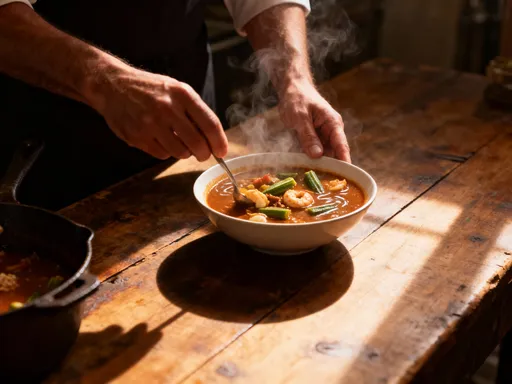
If there’s one dish that embodies the soul of New Orleans, it’s gumbo. I sat down for a bowl at a small Uptown restaurant run by a family that has been cooking together for over 60 years. The gumbo arrived steaming, its surface glistening with a thin layer of oil, the aroma rich and deep. The first spoonful was revelatory—layers of flavor from a dark roux, tender chicken, plump shrimp, and a hint of smoke from andouille sausage. But what made it special wasn’t just the taste; it was the story behind it.
The chef, a woman in her sixties with hands seasoned by decades of stirring pots, explained that her version has been passed down from her grandmother, who learned it from her mother, who was born into slavery. “Every pot is a tribute,” she said. “We don’t write it down. We teach it with our hands.” The recipe includes a choice: thickened with okra, which gives it a slight viscosity and vegetal note, or with filé powder, which adds an earthy depth and is stirred in at the end. “Some families swear by one or the other,” she said with a smile. “In ours, we do both.”
There’s a quiet debate in New Orleans about what makes gumbo “real.” Is it seafood or chicken and sausage? Should it be served over rice or with a side of potato salad? Does it need file or okra? But the truth is, there’s no single correct answer. Every family, every neighborhood, every cook has their version. What matters is the care, the time, and the intention. A good gumbo takes hours—some say 12 or more—to develop its depth. It can’t be rushed. It demands patience, presence, and love. In that way, gumbo isn’t just food. It’s a philosophy.
Food as Connection: Markets, Music, and Community
One Saturday morning, I visited the Crescent City Farmers Market, a vibrant gathering that happens weekly in different neighborhoods. Rows of stalls overflow with fresh produce, handmade bread, local honey, and ready-to-eat dishes. But what made it unforgettable was the music. A small jazz band played in the corner—trumpet, upright bass, and a singer with a voice like honey. People danced with toddlers, tapped their feet while waiting in line, and clapped between bites of crawfish étouffée.
In New Orleans, food and music aren’t separate experiences—they’re two threads of the same fabric. Both are born from struggle, joy, and resilience. Both are shared freely and celebrated loudly. At the market, I spoke with a vendor who grows Creole tomatoes on a small farm outside the city. “We’re not just selling food,” she said. “We’re keeping a way of life alive.” Another vendor, a young chef who returned after working in New York, told me he opened his stall to bring Creole flavors to a new generation. “Tradition doesn’t mean standing still,” he said. “It means evolving without losing your soul.”
These conversations revealed something deeper: food in New Orleans is a form of resistance. After Hurricane Katrina, many restaurants closed, farms were destroyed, and families were displaced. But slowly, steadily, the food culture rebuilt itself. Markets reopened, recipes were revived, and new chefs emerged with a mission to honor the past while feeding the future. To eat here is to participate in that resilience. It’s to say, “I see your history. I respect your work. I value your story.”
Leaving Full, But Not Done Learning
When I left New Orleans, my suitcase was heavier—not just with jars of hot sauce and bags of Creole seasoning, but with a new understanding of what food can be. It’s not just sustenance. It’s memory. It’s identity. It’s a way of saying, “This is who we are.” I used to think of travel as a way to see new places, but now I see it as a way to listen. To sit at a counter, taste a dish, and ask, “How did this come to be?” That question opens doors—to kitchens, to families, to histories that might otherwise go unheard.
Being a respectful food traveler means more than just trying new things. It means supporting local businesses, especially small, family-run ones. It means asking questions with humility, not entitlement. It means understanding that every dish has roots, and those roots run deep. It means not treating culture as a performance, but as a lived experience. In New Orleans, I learned to eat with more than my mouth. I learned to eat with my heart, my curiosity, and my respect.
The city’s food culture isn’t something to be consumed and forgotten. It’s something to be honored. It’s shaped by centuries of survival, creativity, and community. It’s fragile in some ways, yet unbreakable in others. And now, long after the last bite of beignet has faded, I carry it with me—not just in my memories, but in the way I think about every meal. Because in New Orleans, I didn’t just discover new flavors. I discovered a new way of being human.
This journey wasn’t just about discovering new flavors—it was about realizing that food can be a language, a history book, and a bridge. New Orleans taught me to eat with more than my mouth: to listen, to respect, and to remember. The city’s culinary spirit is unbreakable, and now, so is my connection to it.